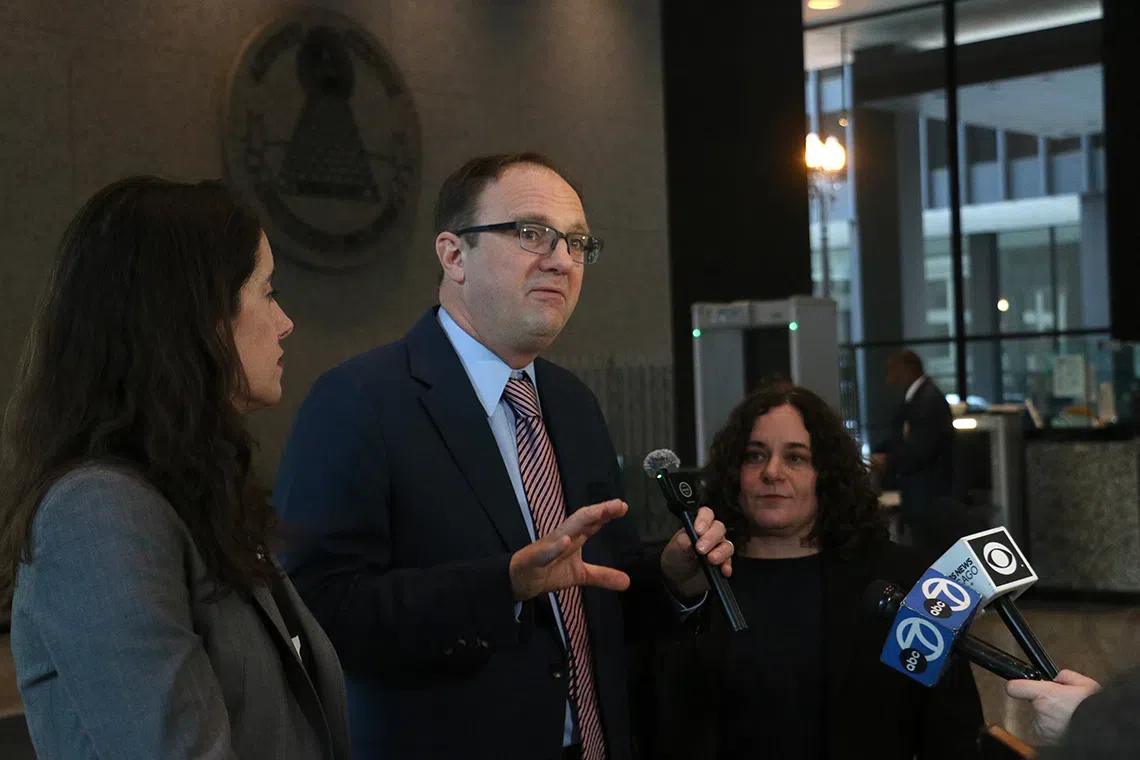
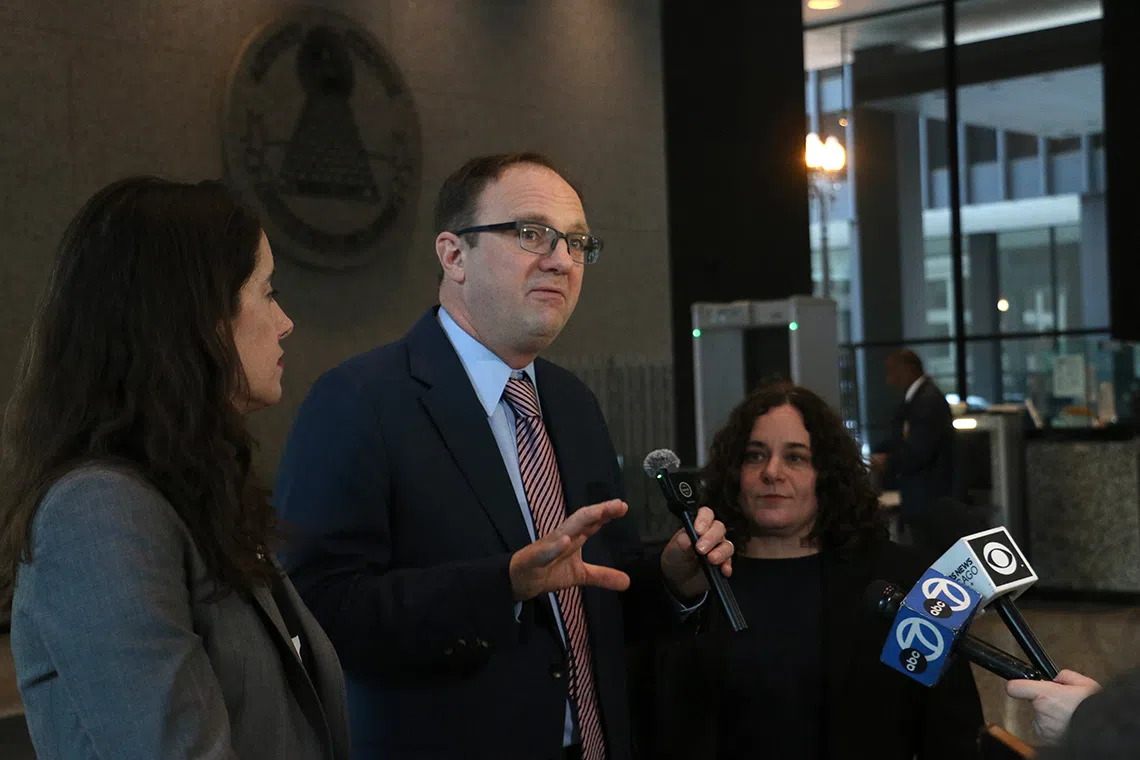
National Immigrant Justice Center attorneys Mark Fleming and Keren Zwick, right, and ACLU of Illinois attorney Michelle García speak to reporters at the Dirksen Federal Courthouse in downtown Chicago after a Feb. 13, 2026, hearing on warrantless immigration arrests amid Operation Midway Blitz. (Capitol News Illinois photo by Maggie Dougherty)
Article Summary
- Federal Judge Jeffrey Cummings ordered the Department of Homeland Security on Friday to release four people arrested without warrants amid ‘Operation Midway Blitz’ by Monday evening. He specified that those released under the order should be released without conditions such as bond or parole.
- Cummings ordered the government to recirculate the warrantless arrests policy nationwide, ruling that a recent memo by ICE Acting Director Todd Lyons is “inconsistent” with a consent decree governing the Midwest.
- He also directed DHS to give attorneys for those in custody at least 12 hours’ notice before release to allow them to assist with pickup and transport of those people, all of whom are held in detention facilities outside the state.
- Cummings also told the department’s attorneys to begin filing weekly reports on their progress providing arrest documentation, which plaintiffs say is behind schedule.
This summary was written by the reporters and editors who worked on this story.
CHICAGO — A federal judge Friday ordered the release by Monday of four people out of hundreds who were detained without warrants by federal agents amid the ‘Operation Midway Blitz’ immigration enforcement campaign last year in the Chicago area.
U.S. District Judge Jeffrey Cummings also rejected a recent agency directive that sought to give immigration agents more discretion to make arrests without warrants.
“It’s been a long road since Operation Midway Blitz, but we are finally, finally at the point where we’re starting to see people get released,” National Immigrant Justice Center attorney Mark Fleming said after the hearing.
“We feel more motivated than ever after the hearing we just had, and the various orders that are going to be coming out, to really finally force this administration to honor their agreement, to honor the consent decree, and frankly, to start following the law as it comes to warrantless arrests.”
Friday’s rulings come after a federal appeals court rejected an October order by Cummings to release hundreds of immigrants arrested without warrants.
Of 615 people originally arrested between June 11, 2025 and Oct. 7, 2025, the government said 173 were still in custody as of Feb. 2. However, plaintiffs say they expect many more were arrested without warrants and proper cause since the list was compiled last fall.
Under a consent decree signed during the Biden administration that limits immigration agents’ authority to make warrantless arrests in six Midwestern states, agents have been prohibited from making warrantless arrests without considering a person’s likelihood of escape before a warrant for the arrest can be obtained. The decree, originally set to expire in May 2025, was extended by Cummings until Feb. 2, 2026. Now, it will be lifted after the alleged violations raised by immigration advocates are resolved.
The decree has required since May 2022 that an assessment of the person’s likelihood to escape includes factors such as their community ties, job history, family, home or lack thereof and past attempts to evade immigration enforcement.
The rationale behind considering those factors is that those with strong ties to their communities are likely to follow traditional removal proceedings while utilizing detention alternatives, such as check-in calls, GPS ankle or wrist devices, or smart phone facial recognition technology to verify location.
Read more: Court scrutiny of ICE mounts as judge rules warrantless arrests violated order | Appeals court won’t release detained immigrants amid warrantless arrest scrutiny
Immigration and Customs Enforcement’s alternatives to a detention program allows people “to remain in their communities — contributing to their families and community organizations and, as appropriate, concluding their affairs in the U.S. — as they move through immigration proceedings or prepare for departure,” according to the program webpage.
ICE’s website also describes the program as cost effective, costing around $4 per day per person, compared to the $152 per day cost of detention. ICE data shows that nearly 180,000 people have been enrolled in detention alternative options so far this year. Of those, 97.5% have attended their court appearances.
The Lyons memo
In a memo issued in late January, ICE Director Todd Lyons sought to upend that precedent by reinterpreting the definition of likelihood of escape to refer to escape at the time of encounter, rather than to leave the area before a warrant could be obtained and the person could be arrested at home or at their place of employment.
Read here: Lyons Memo 1.28
Rather than considering community engagement factors, Lyons directed ICE agents that they may conduct warrantless arrests considering only factors like the person’s behavior and their “ability and means to promptly depart the scene of the encounter.”
The immigrants’ rights advocates argued that the memo “wholly ignores, undermines and effectively supplants” the consent decree.
Cummings agreed, calling it “inconsistent” with the requirements of the decree. The first couple pages of the Lyons memo, he said, looked good to him.
“But where we run into issue is this question of likelihood of escape compared with risk of flight,” Cummings said. “The Broadcast Policy of the decree does not make any distinction between likelihood of escape and risk of flight.”
The Broadcast Statement of Policy lays out requirements that DHS must follow for warrantless arrests and vehicles stops under the consent decree.
Though he acknowledged the lawyers in the room may be able to find a reading of the Lyons memo and the Broadcast Policy, Cummings said he would not expect an agent working in the field to take the time to reconcile the two, leading to potential use of the Lyons memo to justify warrantless arrests which are not permitted under the decree.
While the decree itself only covers Illinois, Indiana, Wisconsin, Kansas, Kentucky and Missouri, ICE was required to issue the Broadcast statement as a nationwide policy and to train all ICE officers on its requirements.
Cummings ordered DHS to resend the Broadcast statement to all agents nationally and communicate that it will be in effect until the decree is lifted.
Notice of release
Plaintiffs also requested that DHS provide notice to them before releasing those detained under the decree.
Government lawyers argued it was considered a law enforcement security risk to telegraph motions such as release in advance and that having to give notice might result in further delays for release.
Those detained by ICE in Illinois are often sent to one of 20 detention facilities in surrounding states, or sometimes further away. Attorneys representing those detained said they are often released late at night into very hot or very cold climates without appropriate attire.
“There is a scramble to find people in the state where the person was released to then literally caravan the person back to the Chicago area,” Fleming told reporters. “We were begging the government just give us some notice so that we can facilitate safe returns for individuals.”
Cummings directed DHS to give at least 12 hours’ notice of release to attorneys for those detained to allow attorneys to coordinate pickup and transport of them from custody.
Of hundreds of people released so far, attorneys said there had been “absolutely no notice” for any of them.
Conditions for release, such as bond or check-in requirements, should be lifted for all those released, Cummings ruled. That should include those already released. They will still be required to attend court appointments and respond to notices from the government.
Cummings also ordered DHS attorneys to begin reporting weekly on its production of arrest records to the attorneys representing immigrants, who said the records are needed to identify additional potential violations of the consent decree.
“What we’ve been seeing in the records is that people were either warrantlessly arrested, in which they either put boilerplate or no justification for flight risk, or they were trying to do these warrants in the field,” Fleming said.
That number may be in the hundreds, if not thousands, he said, who were arrested without a targeted cause. Only a “significant minority,” had prior criminal convictions, Fleming added.
Capitol News Illinois is a nonprofit, nonpartisan news service that distributes state government coverage to hundreds of news outlets statewide. It is funded primarily by the Illinois Press Foundation and the Robert R. McCormick Foundation.