Article Summary
- Democrats have occupied all six statewide constitutional offices since 2019 and are hoping to continue their winning streak in November.
- The Republican field is far less funded and has much less name recognition than the mostly incumbent Democratic slate.
- The GOP slate nonetheless said they have a compelling argument that Democrats have failed to improve the lives of Illinoisians’ and believe the election results will reflect that.
This summary was written by the reporters and editors who worked on this story.
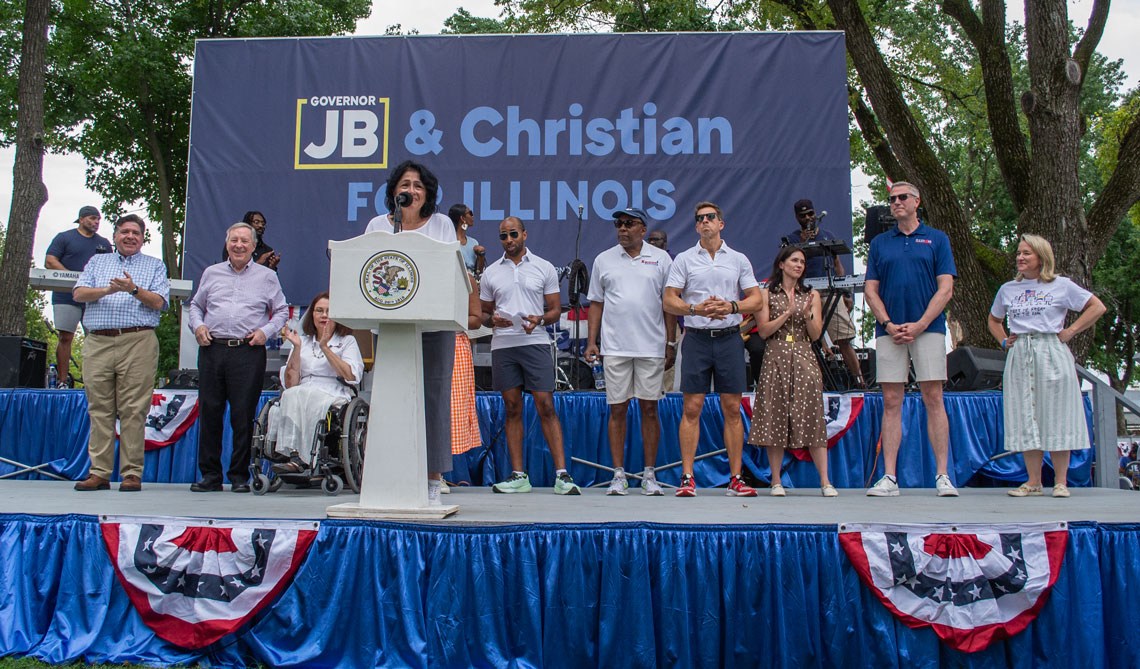
When Illinois’ Democrats gathered for their annual rally at the state fair in August, they reached from one end of the stage to the other.
The party’s candidates have occupied all six statewide constitutional offices since 2019 and are hoping to continue their winning streak in November against a Republican field that’s received much less financial support and has limited name recognition.
Democrats haven’t lost a statewide race since 2014, when Republican Gov. Bruce Rauner and Comptroller Judy Baar Topinka won their races. Four years later, Democrats won all statewide offices as a blue wave swept the nation during President Donald Trump’s first midterm election. The party is looking to continue that trend this year in a similar political climate.
Aside from the comptroller and Senate races, every other race for statewide office features established incumbents. And unlike 2022, when the Republican slate included two seasoned state lawmakers and a county auditor, the GOP’s candidates in 2026 — save for its repeat nominee for governor — are largely unknown faces in state politics or have achieved perennial status.
No Republican even bothered to submit petitions to run for treasurer, leading little-known attorney Max Solomon to wage a write-in campaign to earn a spot on the November ballot.
The GOP slate nonetheless said they have a compelling argument that Democrats have failed to improve the lives of Illinoisians’ and believe the election results will reflect that. They argued, at the very least, that some Republican checks were needed in Democrat-dominated Springfield.